Overlord RAT
- 40
- Global rank
- 29
- Month rank
- 21
- Week rank
Overlord RAT is a cross-platform remote access framework with Go-based agents and a TypeScript/Node/Bun server. It supports encrypted WebSocket C2, remote control, persistence, and multiple operating systems, including Windows, Linux, and macOS.
- RAT
- Type
- Unknown
- Origin
- 1 June, 2026
- First seen
- 20 October, 2026
- Last seen
How to analyze Overlord RAT with ANY.RUN
IOCs
IP addresses
- 2.23.246.101
- 57.153.246.3
- 23.3.89.112
- 48.192.1.65
- 176.65.144.145
- 150.171.109.100
- 20.190.159.75
- 204.79.197.203
- 162.159.142.9
- 135.233.95.144
- 74.179.77.164
- 72.246.29.11
- 172.211.123.248
- 23.11.40.157
- 185.178.208.176
- 1.1.1.1
- 142.215.53.55
- 104.16.249.249
- 150.171.109.105
- 69.41.175.195
Hashes
- 96ad1146eb96877eab5942ae0736b82d8b5e2039a80d3d6932665c1a4c87dcf7
- f49b515eedeed1abe391bc32f15ce43d3582cb6c41ff944fa9c79f476d5824ba
- c55e5baca2162ac54e70de00a3d25b8a9a54617965eb36d1d7080f7d2e0460d7
- 9fb6061b0e07af1814fd7b93a04b59d1004a36656f7cd51c26eeb860e94d63e5
- a4e5b9e377a10dcf8f4a8be4ab389a947396f0232a4bf36b69473871b5488dce
- 923242a721d68e22efa323941768297a9f74ab9be16985378d721023163abef7
- f264ab1dca8c582315291206ca24385fa5fc3aafc69b515d4869d1de4dc0a849
- aec132328dd607a73f2c6105bd2c6876906bc982328312641a15994fbd3dd7b0
- fcb57a19abf2199584657ed4afb3004870c7bdaa5a9fd0cca7e5ae53af74abd5
- b1e3fcf90e41e9b07474cb703e3f98719650df4bc7b8ba91bbeb48d096767f3b
- 8f795b64ad633f28b00f7e13f08809cdd5846554fee04fb4bd82098bd52378d0
- bd013adfdba81218f5be98c4771bb994d22124249466477ba6a965508d0164e0
- e502c6b880ff58d614901495a9009c136539cd0b1e2a2abb8fc00b934c203419
- 28bc1c1bf403d85e3b14593ccf2aacacba87d778fd8ca31f312a800263be248a
- cebbeb18bfeae1c4479c44a0dd2b2201694efd1b2c9c00094785f2111089e1ab
- a113f192195f245f17389e6ecbed8005990bcb2476ddad33f7c4c6c86327afe5
- 2e9fbcd8f7fdc13a5179533239811456554f2b3aa2fb10e1b17be0df81c79006
- e1e4f5155799654ee1ee6603d49ab639735ee1fc5e91d36f868594919bac4690
- 98bdbcb33cb52af137349856a2be633666aba7c830a650d4fbb8301996398344
- 384b8f364b7316aa75c48702175868a0472c45f1ec2bad54bb0da2b92a71eaa7
Domains
- self.events.data.microsoft.com
- fe3cr.delivery.mp.microsoft.com
- crl.microsoft.com
- login.live.com
- ecs.office.com
- client.wns.windows.com
- oneocsp.microsoft.com
- settings-win.data.microsoft.com
- slscr.update.microsoft.com
- activation-v2.sls.microsoft.com
- nexusrules.officeapps.live.com
- ocsp.digicert.com
- google.com
- www.bing.com
- www.microsoft.com
- antivirussoftware.info
- api6.my-ip.io
- release-assets.githubusercontent.com
- 59.37.30.212.in-addr.arpa
- cloudflare-dns.com
URLs
- http://crl.microsoft.com/pki/crl/products/microoceraut2011_2011_03_22.crl
- http://www.microsoft.com/pkiops/crl/microsoft%20secure%20server%20ca%202026.crl
- http://ocsp.digicert.com/mfewtzbnmeswstajbgurdgmcgguabbtrjrydryt%2bapf3gspypfhbxr5xtqqus9tippmhxdiunkhmewnpyim8s8yceajtxtab8my1oj8mfwpz%2f7y%3d
- http://oneocsp.microsoft.com/ocsp/mfqwujbqme4wtdajbgurdgmcgguabbq3l3%2f%2fa6adk8nray2gxzvayrhg4aqub6t%2b2v%2bxq3lso2d33ojhnyhhqoucezmaaaafuwohyjguzpcaaaaaaau%3d
- http://ocsp.digicert.com/mfewtzbnmeswstajbgurdgmcgguabbq50otx%2fh0ztl%2bz8sipi7wewvxdlqqutijuibiv5unu5g%2f6%2brks7qyxjzkceaz1vqyrvgl0erhqlcpm8gy%3d
- https://login.live.com/rst2.srf
- https://login.live.com/ppsecure/deviceaddcredential.srf
- http://www.microsoft.com/pkiops/crl/microsoft%20ecc%20update%20secure%20server%20ca%202.1.crl
- https://slscr.update.microsoft.com/sls/%7b522d76a4-93e1-47f8-b8ce-07c937ad1a1e%7d/x64/10.0.19045.4046/0?ch=686&l=en-us&p=&pt=0x30&wua=10.0.19041.3996&mk=dell&md=dell
- https://fe3cr.delivery.mp.microsoft.com/clientwebservice/ping
- https://slscr.update.microsoft.com/sls/ping
- https://slscr.update.microsoft.com/sls/%7be7a50285-d08d-499d-9ff8-180fdc2332bc%7d/x64/10.0.19045.4046/0?ch=686&l=en-us&p=&pt=0x30&wua=10.0.19041.3996&mk=dell&md=dell
- https://activation-v2.sls.microsoft.com/slactivateproduct/slactivateproduct.asmx?configextension=retail
- https://settings-win.data.microsoft.com/settings/v3.0/flightsettings/fsservice?processorclockspeed=3094&isretailos=1&oemmanufacturername=dell&flightingpolicyvalue=3&enablepreviewbuilds=4294967295&osversionfull=10.0.19045.4046.amd64fre.vb_release.191206-1406&managepreviewbuilds=3&branchreadinesslevelsource=0&attrdataver=186&processorcores=6&branchreadinesslevelraw=16&totalphysicalram=6144&tpmversion=0&oemmodelnumber=dell&systemvolumetotalcapacity=260281&deviceid=s%3abad99146-31d3-4ec6-a1a4-be76f32ba5d4&app=fss&appver=10.0&smartactivehoursstate=1&activehoursstart=20&securebootcapable=0&activehoursend=13&devicefamily=windows.desktop
- https://settings-win.data.microsoft.com/settings/v3.0/wsd/waasassessment?os=windows&osver=10.0.19041.1.amd64fre.vb_release.191206-&ring=retail&sku=48&deviceclass=windows.desktop&locale=en-us&deviceid=bad99146-31d3-4ec6-a1a4-be76f32ba5d4&flightring=retail&telemetrylevel=1&hidovergattreg=c%3a%5cwindows%5csystem32%5cdriverstore%5cfilerepository%5chidbthle.inf_amd64_9610b4821fdf82a5%5cmicrosoft.bluetooth.profiles.hidovergatt.dll&appver=10.0&processoridentifier=amd64%20family%2023%20model%201%20stepping%202&oemmodel=dell&updateoffereddays=4294967295&processormanufacturer=authenticamd&installdate=1661339444&oemmodelbaseboard=&branchreadinesslevel=cb&oemsubmodel=j5cr&isclouddomainjoined=0&deferfeatureupdateperiodindays=30&isdeviceretaildemo=0&flightingbranchname=&osuilocale=en-us&devicefamily=windows.desktop&wuclientver=10.0.19041.3996&uninstallactive=1&isflightingenabled=0&osskuid=48&processorclockspeed=3094&totalphysicalram=6144&securebootcapable=0&app=waasassessment&processorcores=6¤tbranch=vb_release&installlanguage=en-us&deferqualityupdateperiodindays=0&servicingbranch=cb&oemname_uncleaned=dell&tpmversion=0&primarydisktotalcapacity=262144&installationtype=client&attrdataver=186&processormodel=amd%20ryzen%205%203500%206-core%20processor&isedgewithchromiuminstalled=1&osversion=10.0.19045.4046&ismdmenrolled=0&activationchannel=retail&honorwufbdeferrals=0&firmwareversion=a.40&trendinstalledkey=1&osarchitecture=amd64&defaultuserregion=244&updatemanagementgroup=2
- https://settings-win.data.microsoft.com/settings/v3.0/wsd/waasassessment?os=windows&osver=10.0.19041.1.amd64fre.vb_release.191206-&ring=retail&sku=48&deviceclass=windows.desktop&locale=en-us&deviceid=bad99146-31d3-4ec6-a1a4-be76f32ba5d4&flightring=retail&telemetrylevel=1&hidovergattreg=c%3a%5cwindows%5csystem32%5cdriverstore%5cfilerepository%5chidbthle.inf_amd64_9610b4821fdf82a5%5cmicrosoft.bluetooth.profiles.hidovergatt.dll&appver=10.0&processoridentifier=amd64%20family%2023%20model%201%20stepping%202&oemmodel=dell&updateoffereddays=4294967295&processormanufacturer=authenticamd&installdate=1661339444&oemmodelbaseboard=&branchreadinesslevel=cb&oemsubmodel=j5cr&isclouddomainjoined=0&deferfeatureupdateperiodindays=30&isdeviceretaildemo=0&flightingbranchname=&osuilocale=en-us&devicefamily=windows.desktop&wuclientver=10.0.19041.3996&uninstallactive=1&isflightingenabled=0&osskuid=48&processorclockspeed=3094&totalphysicalram=6144&securebootcapable=0&app=waasassessment&processorcores=6¤tbranch=vb_release&installlanguage=en-us&deferqualityupdateperiodindays=0&servicingbranch=cb&oemname_uncleaned=dell&tpmversion=0&primarydisktotalcapacity=262144&installationtype=client&attrdataver=186&processormodel=amd%20ryzen%205%203500%206-core%20processor&isedgewithchromiuminstalled=1&osversion=10.0.19045.4046&ismdmenrolled=0&activationchannel=retail&honorwufbdeferrals=1&firmwareversion=a.40&trendinstalledkey=1&osarchitecture=amd64&defaultuserregion=244&updatemanagementgroup=2
- https://eth.llamarpc.com/
- https://eth.api.onfinality.io/public
- https://ethereum-rpc.publicnode.com/
- https://antimalwarediagnostics.st/api/bundle
Last seen at
Key Takeaways
- Cross-Platform RAT: Overlord RAT is a publicly available cross-platform RAT framework with Go-based agents and a server component built with TypeScript and Node/Bun.
- Remote Access: The framework provides operators with remote access to compromised systems through a centralized C2 infrastructure.
- Encrypted C2: Overlord RAT supports encrypted WebSocket communication using WSS for communication between agents and the C2 server.
- Web-Based Control: Operators can manage connected agents through a web-based interface or Electron client.
- Persistence: Overlord RAT supports mechanisms that can help maintain access to compromised systems beyond the initial execution.
- Masquerading: The framework can employ techniques such as legitimate-looking filenames or system component names to make malicious activity less conspicuous.
- C2 Tunneling: Overlord RAT can use tunneling services such as ngrok as part of its C2 infrastructure, potentially obscuring the underlying server.
- Multi-Platform Support: The framework supports Windows, Linux, and macOS, allowing it to operate across different operating system environments.
- ANY.RUN’s Interactive Sandbox analysis provides visibility into Overlord RAT’s execution behavior, including host discovery, remote communication, and activity performed after the malware becomes active on the system.
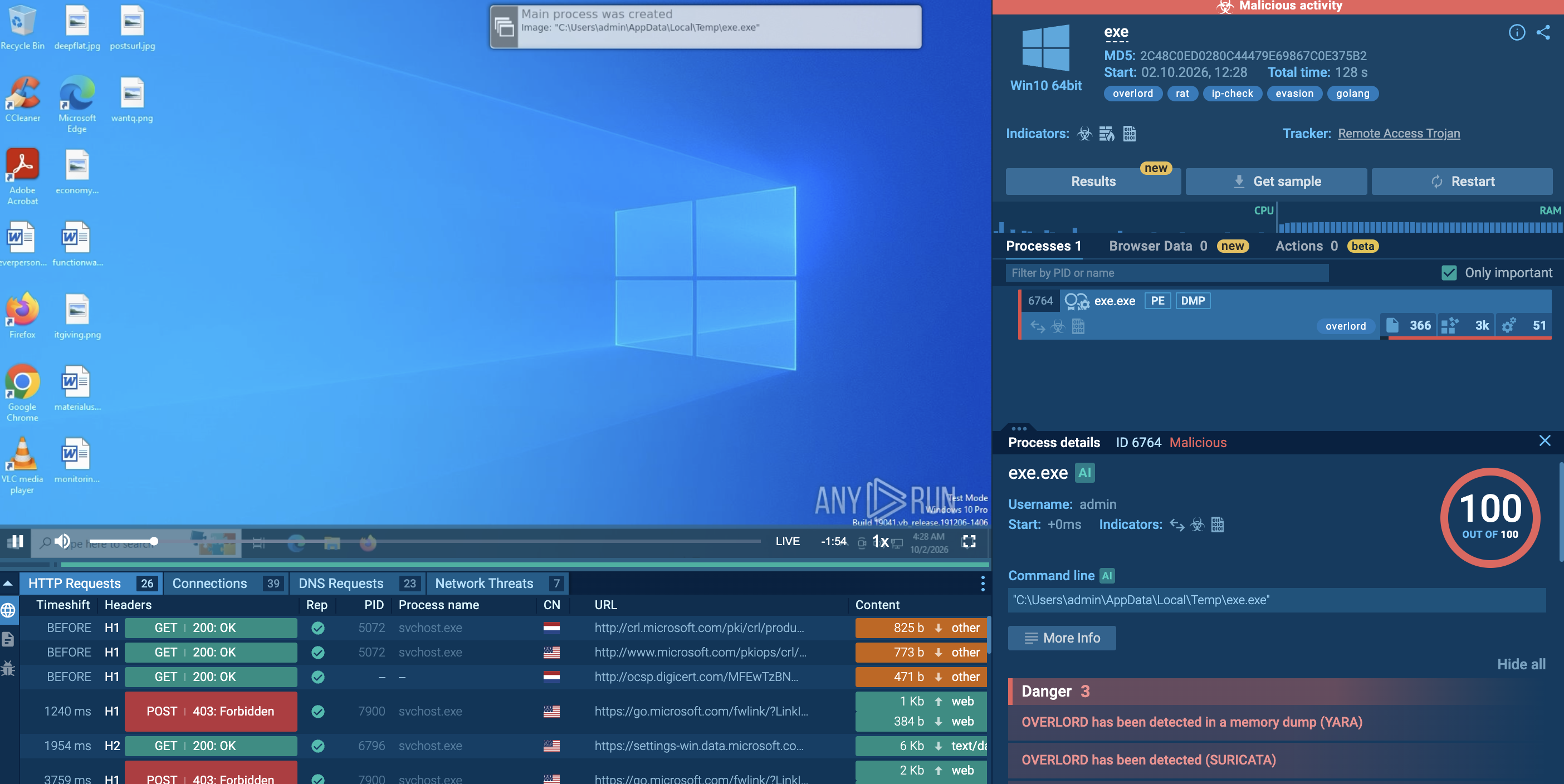
What is Overlord RAT?
Overlord RAT is a publicly available cross-platform remote access trojan (RAT) framework designed to provide remote access to compromised systems.
The framework uses Go-based agents, while its server-side components are implemented using TypeScript with Node.js/Bun. Operators can manage connected agents through a web-based interface or an Electron client.
Communication between agents and the C2 server takes place over encrypted WebSocket connections (WSS), providing a channel for exchanging commands and information.
The framework supports Windows, Linux, and macOS, making it applicable across multiple operating system environments. Its continued development also means that capabilities and implementation details may change between versions.
How Overlord RAT Affects Businesses and Organizations
An Overlord RAT infection can create several risks for organizations, including:
- Unauthorized remote access: The RAT can provide an operator with remote access to a compromised endpoint.
- Persistence: The Windows sample analyzed in this article uses multiple persistence mechanisms to maintain access after execution.
- System masquerading: Names associated with legitimate Windows processes and components can make malicious activity less obvious during an initial investigation.
- C2 exposure: Communication with remote infrastructure provides an external channel through which an operator can control an infected system.
- Infrastructure concealment: The observed use of an ngrok tunnel can make identifying the attacker's underlying infrastructure more difficult.
- Cross-platform exposure: Because the framework supports Windows, Linux, and macOS, organizations using different operating systems may need to account for the framework across multiple environments.
- Follow-on activity: Remote access can provide an operator with an entry point for additional activity on the compromised system.
Victimology: Potential Targets of Overlord RAT
Overlord RAT supports Windows, Linux, and macOS, potentially exposing organizations that operate mixed-OS environments.
The framework is not described as being restricted to a specific industry or sector. Its general-purpose remote-access capabilities can potentially be applied to a broad range of environments.
The impact of an infection can depend on the privileges available to the compromised agent, the system on which it is running, the configuration of the RAT, and the actions performed by the operator.
How Does Overlord RAT Function?
Observing an Overlord RAT sample inside ANY.RUN’s Interactive Sandbox shows that Overlord RAT uses a client-server architecture in which lightweight agents communicate with a central server operated through a web-based or Electron interface.
The agents are written in Go, while the server component uses TypeScript and Node.js/Bun. Communication between agents and the server takes place over encrypted WebSockets (WSS).
The observed Windows sample additionally uses several techniques intended to maintain access and make the malware appear less suspicious.
The general execution flow can be summarized as:
Agent execution → Persistence → Process masquerading → Encrypted C2 communication → Remote control
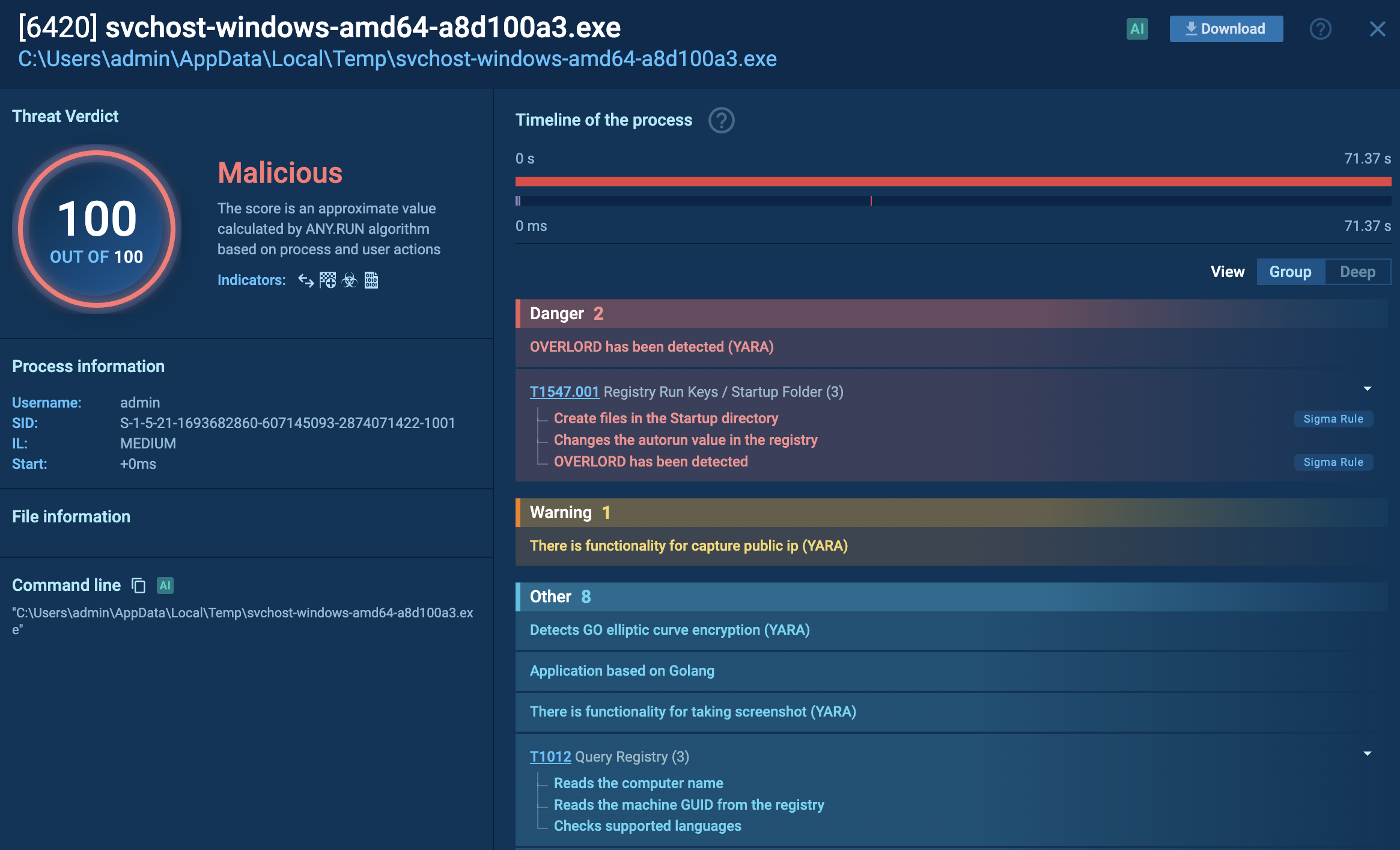
Stage 1: Agent Execution
Overlord RAT operates through an agent deployed to the target system.
The framework supports multiple operating systems, including Windows, Linux, and macOS. The Go-based agent is responsible for establishing communication with the server and carrying out actions received through the C2 channel.
On Windows, the analyzed sample is named: svchost-windows-amd64-a8d100a3.exe
The filename resembles the naming convention used by legitimate Windows system processes, helping the executable blend into the host environment.
Stage 2: Persistence Through Multiple Locations
The analyzed Windows sample establishes persistence using more than one mechanism.
First, the malware copies itself to: AppData\Roaming\Microsoft\DeviceSync\svchost.exe
It also places a copy in the Startup folder, allowing the malicious executable to be launched when the user logs into Windows.
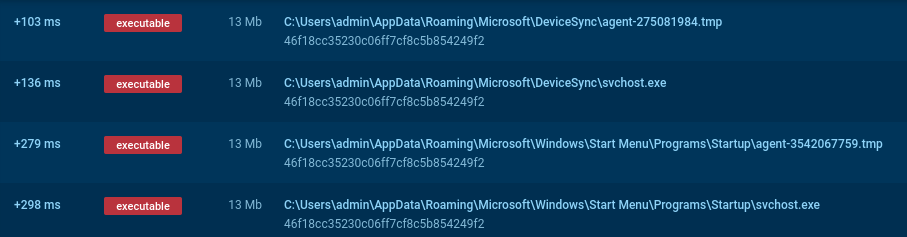
In addition, the sample modifies a Windows Registry autorun key to establish another startup mechanism.
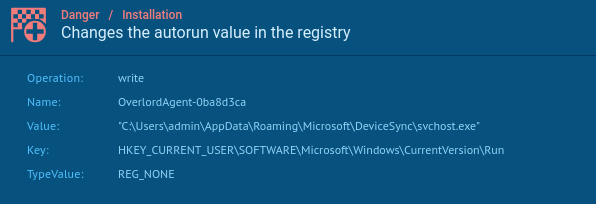
This combination provides redundant persistence, meaning that the malware has multiple ways to regain execution if one mechanism is removed.
Stage 3: Mutex Masquerading
The sample creates a mutex using a name associated with a legitimate Windows component: Global\BFE_Notify_Event_{...}

The use of a name associated with the Windows Base Filtering Engine (BFE) can make the mutex appear less suspicious during analysis and may help the malware avoid standing out among legitimate system objects.
A mutex can also help malware coordinate execution and prevent multiple instances of the same component from running simultaneously.
Stage 4: Encrypted C2 Communication
After establishing itself on the system, the agent communicates with the Overlord server using encrypted WebSocket connections (WSS).
This provides a persistent communication channel through which the agent and server can exchange information and commands.
The framework's server component is implemented using TypeScript and Node.js/Bun, while operators can interact with connected agents through a web panel or Electron client.
Stage 5: C2 Through an Ngrok Tunnel
The analyzed sample communicates with its C2 through an ngrok tunnel.

Ngrok provides a tunnel between the infected system and the remote service, which can obscure the attacker's underlying infrastructure from the victim's network.
For defenders, this means that the visible destination may belong to the tunneling service rather than directly revealing the infrastructure operated by the attacker.
Stage 6: Remote Control
Once the agent establishes its C2 connection, the framework provides the operator with a mechanism for remotely managing the compromised host.
Commands can be issued through the framework's control interface and transmitted to connected agents through the C2 channel.
This remote-access capability is the central function of Overlord RAT and distinguishes it from malware designed solely for information collection or payload delivery.
Stage 7: Persistence
Unlike Windows-only RATs, Overlord is designed as a cross-platform framework. Its agents support Windows, Linux, and macOS.
This architecture allows the same broader framework to be deployed across different operating system environments, although specific functionality may depend on the agent and platform.
Understanding Overlord RAT Behavior
The analyzed Windows sample demonstrates several notable behaviors:
- Go-based agent provides the malware's endpoint component.
- Windows process masquerading uses the filename svchost-windows-amd64-a8d100a3.exe.
- Multiple persistence mechanisms place copies in the DeviceSync directory and Startup folder while modifying a Registry autorun key.
- Mutex masquerading uses a name associated with the legitimate Windows BFE component.
- Encrypted WebSocket communication provides the C2 channel between the agent and server.
- Ngrok tunneling is used to route C2 traffic and conceal the underlying infrastructure.
- Web/Electron management provides operators with an interface for controlling connected agents.
- Cross-platform support extends the framework to Windows, Linux, and macOS.
Together, these capabilities allow Overlord RAT to establish a persistent presence, communicate with remote infrastructure, and provide operators with remote access to compromised systems.
How Threat Intelligence Can Help Investigate Overlord RAT
Because Overlord is a developing RAT/framework, samples may differ in configuration, filenames, infrastructure, and implementation. Defenders should therefore combine static indicators with behavioral and network analysis.
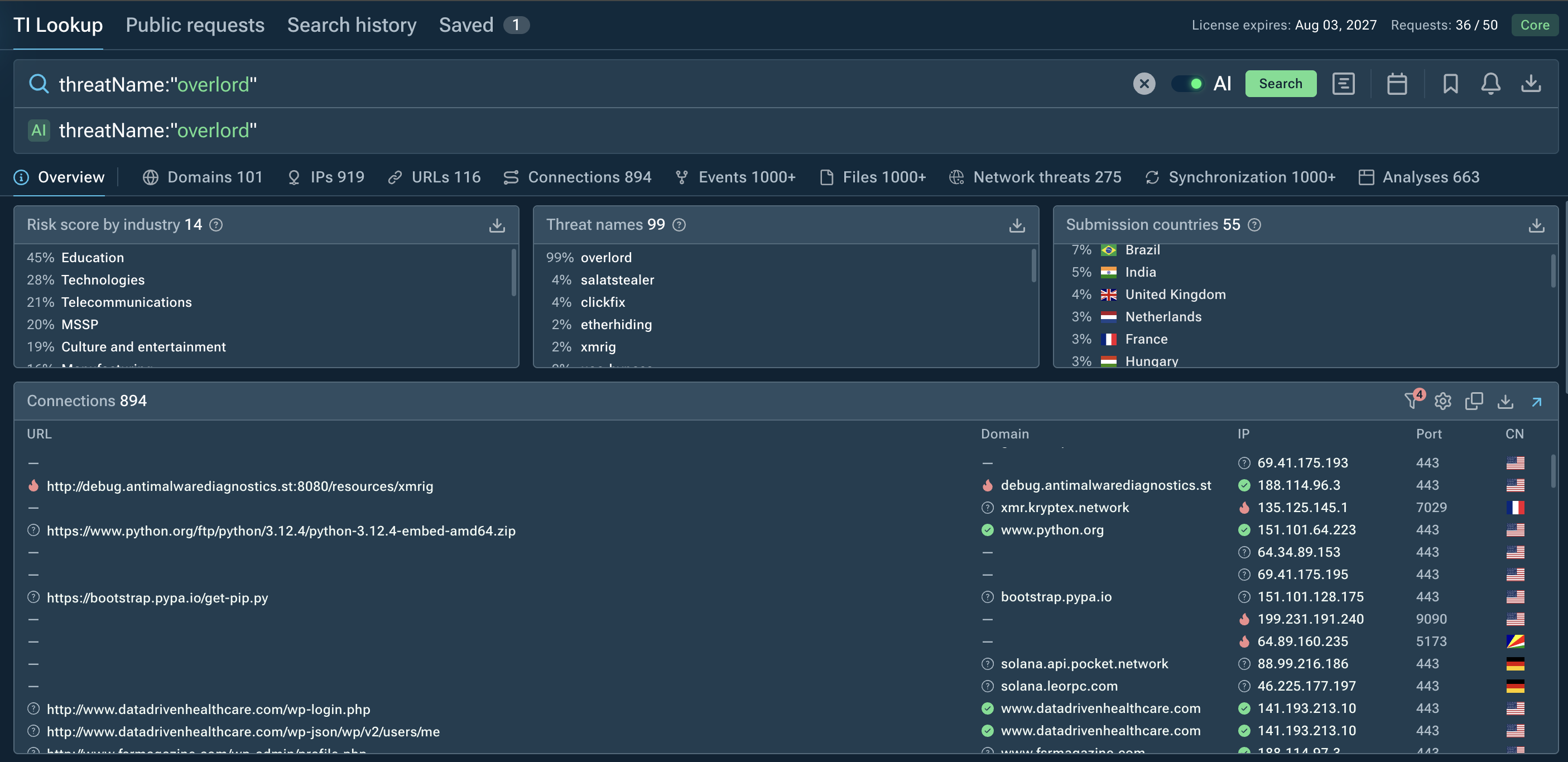
ANY.RUN’s Threat Intelligence can help analysts investigate suspicious Overlord activity by connecting samples with associated infrastructure and observable behaviors.
Threat Intelligence Lookup can be used to pivot from a suspicious sample or indicator toward:
- Related Overlord RAT samples
- Associated domains and IP addresses
- C2 infrastructure
- WebSocket or WSS connections
- Persistence mechanisms
- Suspicious Registry modifications
- Startup-folder activity
- Mutex names
- Related processes and files
- Previous sandbox executions
Overlord RAT Detection Indicators
Defenders investigating potential Overlord RAT activity can monitor for:
- Executables using names that resemble legitimate system processes
- Unexpected copies of executables in user Startup locations
- New files under unusual AppData directories
- Registry autorun modifications associated with unknown executables
- Creation of mutexes using names associated with legitimate Windows components
- Unexpected WSS/WebSocket connections from suspicious processes
- Network connections involving ngrok infrastructure
- Persistent outbound connections from newly executed binaries
- Suspicious cross-platform RAT agents appearing on organizational endpoints
These behaviors can provide useful detection opportunities even when filenames, hashes, or C2 destinations change.
Overlord RAT Incident Response
If Overlord RAT is identified on an endpoint, organizations should investigate both the malware and the mechanisms used to maintain remote access.
Recommended actions include:
- Isolate the affected endpoint where appropriate.
- Preserve relevant forensic evidence before removing artifacts.
- Identify the original Overlord agent and any copies created during execution.
- Review Startup-folder contents for suspicious executables.
- Inspect Registry autorun locations for recently added entries.
- Investigate suspicious mutex creation and associated processes.
- Review WSS/WebSocket connections made by the suspected agent.
- Investigate ngrok-related network activity associated with the compromise.
- Search other endpoints for matching filenames, paths, registry entries, or behavioral indicators.
- Review authentication and endpoint telemetry for activity associated with the compromised host.
Because Overlord RAT provides remote access, defenders should also investigate what actions may have been performed while the agent was active.
Conclusion
Overlord RAT is a cross-platform remote access framework built around Go-based agents and a TypeScript/Node/Bun server architecture. Its agents communicate with the C2 infrastructure through encrypted WebSocket connections and can be managed through web or Electron-based interfaces.
The analyzed Windows sample demonstrates several behaviors relevant to defenders, including multiple persistence mechanisms, Windows process masquerading, mutex masquerading, encrypted C2 communication, and ngrok-based tunneling.
Monitoring for suspicious Startup and Registry modifications, unusual AppData executables, masquerading filenames, unexpected WSS connections, and ngrok-related traffic can help organizations identify potential Overlord RAT activity.
Frequently Asked Questions: Overlord RAT
1. What is Overlord RAT?
Overlord RAT is a publicly available cross-platform remote access trojan (RAT) framework designed to provide remote access to compromised systems. Its agents are written in Go, while the server component uses TypeScript with Node.js/Bun.
2. Which operating systems does Overlord RAT support?
Overlord RAT supports Windows, Linux, and macOS, allowing the framework to operate across different operating system environments.
3. How does Overlord RAT communicate with its C2 server?
Overlord RAT supports encrypted WebSocket communication using WSS, allowing agents to exchange commands and information with the C2 server.
4. Does Overlord RAT establish persistence?
Yes. Overlord RAT can use persistence mechanisms to help maintain access to compromised systems after the initial execution. The specific mechanisms may vary depending on the platform and implementation.
5. Can Overlord RAT disguise its activity?
Overlord RAT can employ masquerading techniques, such as using filenames or system object names that resemble legitimate components, to make malicious activity less conspicuous.
6. Does Overlord RAT use a mutex?
Overlord RAT can create mutexes as part of its execution. Depending on the implementation, mutex names may also be designed to resemble legitimate system components.
7. Can Overlord RAT use tunneling services for C2?
Overlord RAT can use tunneling services such as ngrok as part of its C2 infrastructure. Such services can provide an intermediary between the agent and remote infrastructure.
8. How can interactive sandboxing and threat intelligence help investigate Overlord RAT?
Interactive sandboxing allows analysts to examine Overlord RAT's execution, persistence, process activity, and network communications.
Threat intelligence can then help connect observed indicators with related samples, infrastructure, and other activity.
Other malware & phishing threats
 DonutLoaderDonutLoader is a versatile, open-source-based in-memory loader that turns .NET assemblies, executables, DLLs, and scripts into position-independent shellcode for execution entirely in RAM. Originally derived from the popular Donut tool, it enables threat actors to bypass traditional antivirus and EDR solutions by avoiding disk writes and injecting payloads directly into legitimate Windows processes.
 SSLoadSSLoad is a malicious loader or downloader that is used to infiltrate target systems through phishing emails, perform reconnaissance and transmit it back to its operators delivering malicious payloads. To avoid detection, SSLoad employs various encryption methods and delivery techniques highlighting its versatile nature and complexity. It is believed to be a part of Malware-as-a-Service (MaaS) operation given its diverse delivery methods and implemented techniques.
 XRedXRed operates as a stealthy backdoor, enabling cybercriminals to gain unauthorized remote access to infected systems. XRed has gained particular notoriety for its distribution through trojanized legitimate software and hardware drivers, making it exceptionally dangerous due to its ability to masquerade as trusted applications.
 PonyPony is a malware with two main functions — stealing information and dropping other viruses with different tasks on infected machines. It has been around since 2011, and it still actively attacks users in Europe and America.
 Pulsar RATPulsar RAT is a derivative of Quasar RAT with extensive functionality including keylogging, cryptocurrency wallet clipping, credential theft, file management, remote shell execution, and data exfiltration capabilities. As a modular, open-source remote administration tool designed for Windows systems, Pulsar introduces significant enhancements over its predecessor.
 DEVMANDEVMAN is a fast-evolving malware family targeting Windows environments with a mix of credential theft, remote control capabilities, and persistence techniques typical of modern crimeware. Initially observed in early 2025, DEVMAN quickly became a favorite tool among cybercriminal groups thanks to its stealth, modular structure, and ability to bypass traditional AV solutions.